
The Importance of Performance Marketing in Digital Marketing: A Complete Guide
Why are businesses shifting rapidly toward performance marketing?
If you’ve ever spent money on marketing and wondered, “Where did that budget actually go?”—you’re not alone. That question has haunted business owners for decades. Traditional marketing often felt like throwing flyers into the wind and hoping a few land in the right hands.
That’s exactly where Performance Marketing in Digital Marketing steps in like a breath of fresh air.
Instead of paying for potential, you pay for results. Clicks, leads, sales—real, measurable outcomes. No fluff. No guesswork. Just numbers that tell a story.
Let’s unpack why this approach has become the backbone of modern marketing—and why ignoring it today is like running a race with your shoelaces tied together.
What is Performance Marketing (and why should you care)?
At its core, Performance Marketing in Digital Marketing is a strategy where advertisers only pay when a specific action happens. That could be a click, a purchase, a sign-up, or even an app download.
Think of it like ordering food online—you don’t pay just because the restaurant exists. You pay when your order actually arrives.
This model puts accountability front and center. Every rupee you spend is tied to measurable outcomes.
And let’s be honest—whether you’re running a startup from your bedroom or managing a corporate brand, accountability is everything.
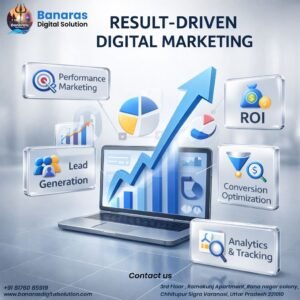
The real reason businesses love performance marketing
Let me tell you a quick story.
A small clothing brand once spent ₹50,000 on billboard ads. They got compliments, a few social media mentions… and almost zero sales.
Frustrated, they switched to Performance Marketing in Digital Marketing using targeted ads. Same budget, different approach.
Result?
They tracked every click, optimized campaigns daily, and turned that ₹50,000 into ₹2,10,000 in revenue.
That’s not magic. That’s precision.
Measurability: No more “marketing guesswork”
One of the biggest advantages of Performance Marketing in Digital Marketing is measurability.
With tools like PPC marketing platforms, you can see:
- Who clicked your ad
- Where they came from
- What they did next
It’s like having X-ray vision for your campaigns.
Compare that to traditional marketing, where success often depends on vague metrics like “brand awareness.” Sounds nice—but try paying your bills with awareness.
Budget control that actually works
Ever felt like marketing budgets disappear faster than snacks at a party?
With cost per click marketing, you’re in control. You decide:
- How much to spend
- When to spend
- Where to spend
No surprises. No runaway expenses.
And the best part? If something isn’t working, you can pause it instantly. Try doing that with a newspaper ad already printed!
Better targeting = better results
Imagine selling winter jackets… in peak summer. Not ideal, right?
That’s the beauty of paid advertising strategies in performance marketing. You can target:
- Specific age groups
- Locations
- Interests
- Behaviors
Your ads don’t just reach people—they reach the right people.
This is why online advertising performance improves dramatically when businesses switch to this model.
ROI that you can actually track
Let’s talk about what really matters—money.
With ROI in digital marketing, performance marketing removes the guesswork. You know exactly:
- How much you spent
- How much you earned
- What worked (and what didn’t)
It’s like having a financial dashboard for your marketing efforts.
And once you see those numbers clearly, decision-making becomes much easier. No more “I think this campaign is doing well.” You know.
PPC marketing: The backbone of performance marketing
If performance marketing were a car, PPC marketing would be its engine.
Pay-per-click campaigns allow you to:
- Appear instantly in search results
- Drive targeted traffic
- Scale quickly
But here’s the catch—it’s not just about spending money. It’s about spending it smartly.
The difference between a successful campaign and a failing one often comes down to optimization.
Conversion Rate Optimization: Turning clicks into customers
Getting traffic is one thing. Converting it? That’s a whole different game.
This is where conversion rate optimization comes in.
Imagine running ads that bring 1,000 visitors to your website… but only 5 people buy. Painful, right?
Now tweak your landing page, improve your messaging, simplify checkout—and suddenly 50 people buy instead.
Same traffic. 10x results.
That’s the power of optimizing what happens after the click.
Affiliate marketing strategies: Performance without risk
Another powerful arm of Performance Marketing in Digital Marketing is affiliate marketing.
Here’s how it works:
You partner with individuals or platforms who promote your product—and you only pay them when they generate results.
No sales? No payment.
Smart, right?
Effective affiliate marketing strategies allow businesses to expand reach without increasing upfront risk. It’s like having a sales team that only gets paid when they actually sell.
Scalability: Grow without limits
One of the most exciting aspects of Performance Marketing in Digital Marketing is scalability.
Once you find a campaign that works, you can:
- Increase budget
- Expand audience
- Replicate success
Unlike traditional marketing, where scaling often means higher risk, performance marketing scales predictably.
It’s like finding a recipe that works—you just cook a bigger batch.
Real-time optimization: Fix things on the go
In the old days, if a campaign failed, you’d realize it weeks later.
With performance marketing? You can adjust in real time.
Using insights from online advertising performance, you can:
- Change creatives
- Adjust targeting
- Test different offers
All while the campaign is still running.
It’s like driving with GPS instead of a paper map—you can reroute instantly.
Why startups and SMEs benefit the most
Big brands have the luxury of experimenting. Small businesses? Not so much.
That’s why Performance Marketing in Digital Marketing is a game-changer for:
- Startups
- Small businesses
- E-commerce brands
With limited budgets, every rupee counts. Performance marketing ensures none of it goes to waste.
It’s lean, efficient, and results-driven—exactly what growing businesses need.
Common mistakes (and how to avoid them)
Let’s keep it real—performance marketing isn’t foolproof. Here are a few traps to watch out for:
1. Ignoring data
If you’re not analyzing results, you’re flying blind.
2. Poor landing pages
Even the best PPC marketing campaigns fail if the destination is weak.
3. Unrealistic expectations
Results take testing and optimization. Overnight success is rare.
4. Focusing only on clicks
Clicks don’t pay bills—conversions do.
Avoid these, and you’re already ahead of many competitors.
The future of performance marketing
If you think Performance Marketing in Digital Marketing is big now, just wait.
With AI, automation, and advanced analytics, campaigns are becoming smarter every day.
We’re moving toward a world where:
- Ads predict user behavior
- Campaigns self-optimize
- Personalization becomes hyper-targeted
And businesses that embrace this shift early? They’ll dominate.
So, is performance marketing worth it?
Short answer? Absolutely.
Long answer?
If you care about:
- Measurable results
- Controlled spending
- Higher ROI in digital marketing
- Scalable growth
Then Performance Marketing in Digital Marketing isn’t just an option—it’s a necessity.
Final thoughts: Think results, not just reach
Marketing isn’t about shouting the loudest anymore. It’s about being heard by the right people—and getting them to act.
That’s what makes Performance Marketing in Digital Marketing so powerful.